The Principles of the Alexander Technique
Alexander Technique Principles
What each lesson teaches you to apply…

“Brain Waves”
to everything you do!
As my Home and About pages describe, folx come to Alexander for a wide range of reasons. No matter why you’re taking AT, in every class, you are being shown how to apply the Technique’s foundational Ideas to yourself (in everything you do) as a way to address your goals or issues.
Don’t worry about memorizing; we learn through doing 😊
Because it’s up to you to begin applying what you discover in lessons to your life activities, it may be helpful for you and your learning style to have an overview or map of the big picture. This post (like most of my descriptive writing on this website) is intended ONLY as a reference or as a supplement to lessons.
If that’s what you’re looking for, scroll away!
(If you want something else? Remember that AT is an experiential, embodied approach. The only way to know what the feeled EXPERIENCE of something is? … is to do it. Schedule a 1st lesson. You can visit other pages here to watch a video of me teaching and another of other AT teachers teaching. I also invite you to read my Blog article What to Expect in Your First Lesson ).
Alexander Technique Principles
1.The Unity of the Self (the Whole Person):
we Humans (like all animals) each Function as an integrated, psychophysical (mind-body-emotion) whole.
Body <---> Brain work together, 24/7 (for better or worse)
nothing we do is purely physical or purely mental or purely emotional or purely _____.
the reality of humans’ natural, integrated whole-person Functioning vs. societal institutions’ compartmentalization of us
Medical, legal, educational (etc.) frameworks still treat us as a collection of disparate parts when humans do not function that way. Therefore, we learn to view ourselves through a series of compartmentalized lenses.
our learned (conscious & unconscious) adaptations to such external constructs impact our internal/ whole-self functioning.
our capacity to be aware of ourselves in action (motor movement) is naturally limited even before imposed compartmentalization. There’s too much happening internally for us to notice.
2. How I Use my Body-Mind effects how I Function:
Manner of Use (Habit vs. Choice) - am I moving/ behaving consciously or unconsciously? Do I habitually compress or tighten or stiffen my body in daily activities (even sleep)? Or do I move in a balanced, easeful, poised way? If I don’t like the way I’m moving, do I have a say in my habit, in the moment I notice it?
Condition(s) of Use (illness, injury, genetics, disease, syndromes, etc)
my Condition(s) of Use will effect my Manner of Use, potentially creating compensatory, whole-Self habits
Example: if I break my right ankle, my weight will shift to the left, and my whole body will compensate for 6 weeks as I try to get around. Then there’s the whole-Self adaptation to fear of pain, fear of falling, plus adaptation to using crutches or a scooter. When my ankle has mended, chances are I still will maintain some of the whole-body compensating habits I developed in those 6 weeks.
my habitual Manner of Use can improve or worsen (or even create) a Condition of Use, which likely will impact my ability to Function as well as I’d like.
Example: if I am engaging in PT exercises meant to address a Condition of carpal tunnel syndrome, but am contracting my biceps or neck or low back or thighs or glutes or feet unnecessarily to do those exercises? I may worsen the initial Condition or create a new problem in a completely different part of me.
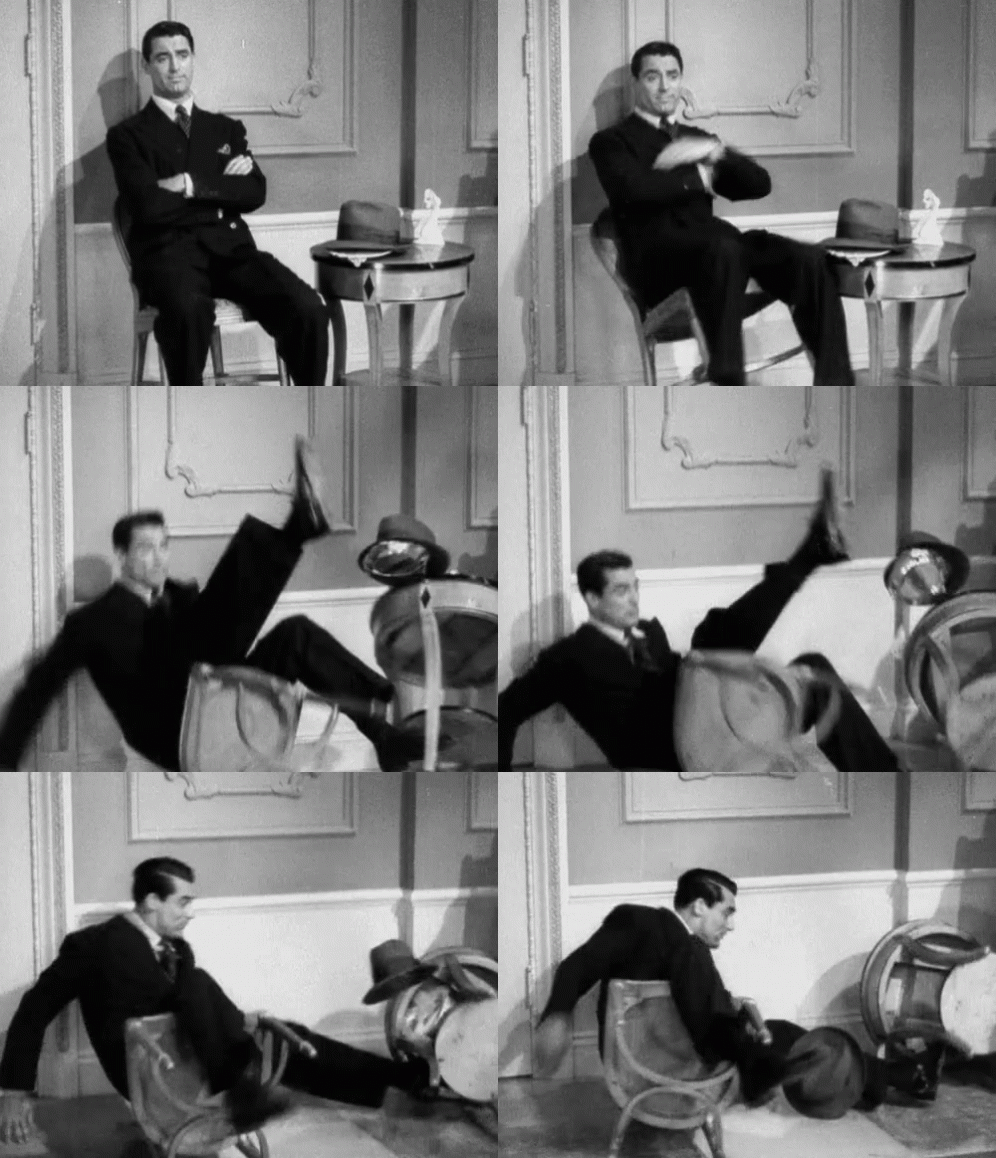
Cary Grant, The Awful Truth (1937)
3. Unreliability of Sensory Perception:
most of us have been trained to become unaware of how our bodies feel beginning in early childhood (esp. once school starts). See #4.
Condition and Manner of Use can interfere with both our awareness and its accuracy (i.e.: proprioception, interoception, exteroception, etc.)
Example: “people keep telling me my head is thrust forward, but I don’t notice it until I’m in a lot of pain; the chiro and massage gets me out of pain for a day or 2; but then I’m back in the same place. Now I’m losing my voice and feel off- balance.”
we can’t change what we don’t notice; however, we can learn how to become more aware and more accurately aware (“brain plasticity”). AT then shows us how to use that new awareness to get the change we want (if we want).
4. “End-gaining” vs. “Means-whereby”
assuming I know what I want, how do I go about getting it? How do I respond to sensory input from my environment or the next thing on my To-do List?
do I go for immediate result/ “try harder”/ “work harder”/“Concentrate”/ “get it right”/ “do it faster?”
can I center process to achieve the result I want?
can I allow for shifts in process and in result (“work smarter”) as I get more info?
5. “Non-Doing”
the pause before action that allows for checking-in with my body-mind-emotion and awarenesses
giving myself time to quiet my nervous system
“Non-doing” is NOT not-doing
6. “Primary Control" (a.k.a. the Head-Neck-Back Relationship)

“The head leads and the body follows”
human movement (internal & external), like that of every other 4-limbed vertebrate, is organized around a naturally lengthening and widening relationship between bones (in the context of all gravitational forces)
as we engage in the acts of living, a central, stabilizing relationship of bony parts occurs, primarily between Head-Neck/Spine-Pelvis
we can observe this relationship working easily and well in most 4-limbed animals and small children
the dynamic oppositions involved in maintaining upright posture are primary for a general, healthy “Manner of Use” and long-term healthy functioning
most of us are born with all this working well and learn to interfere (unconsciously) as Life happens.
putting AT principles into action (which we learn how to do through lessons and through applying what we do in class to Life activities) helps to restore our “Primary Control” to better working order and helps prevent future issues.
7. “Inhibition”/ inhibiting
saying “no" or “pause” to habitual reaction/ contracted motor coordination you may not want (because it creates a result you don’t want)
in the neurological sense, nerves are either “excited” (on) or “inhibited” (off) – this is the flavor of the word (vs. the Freudian sense of it)
8. “ Direction”/ directing
Specific way of constructively guiding/talking to your body to remove impediments to PC coordinating well. Inviting oppositions to release into length and width vs. forcing/ pushing/holding a position.
Analogy: conductor or band leader working with an orchestra to make music = you conducting yourself and your motor habits to walk or run or swim or talk or sing or dance or listen or sit or _________

Please visit my AT Resource Library for a list of recommended books, plus peer-reviewed articles and video that flesh out AT’s foundational ideas using detailed examples.